Recommended: “Couture Design Process: Step-by-Step Guide to a Bespoke Gown”
Couture Design Process: How a Bespoke Gown Comes to Life Couture is where fashion becomes […]
Couture Design Process: How a Bespoke Gown Comes to Life
Couture is where fashion becomes wearable art. The couture design process transforms an idea into a one-of-a-kind garment through meticulous craft, close client collaboration, and a sequence of technical steps that few other disciplines match. Whether you’re commissioning a bespoke piece or studying high fashion, knowing the stages of couture helps you appreciate the time, skill, and coordination involved.
Client consultation and concept
Everything begins with a conversation. The designer meets the client to discuss vision, lifestyle, silhouette preferences, budget range, and any functional requirements. Mood boards, sketches, and fabric swatches are presented to translate inspiration into a workable concept. At this stage the designer balances creativity with wearability and outlines timelines and fitting expectations.
Fabric sourcing and material selection
Couture relies on exceptional materials. Silk faille, handwoven lace, fine tulle, and couture-grade satin are commonly sourced from specialized mills and ateliers. Trimmings—fringe, rare beads, metal threads, and feathers—are selected to complement the design. Sustainable and artisanal sourcing is increasingly prioritized, with couture houses partnering directly with textile artisans to ensure quality and traceability.
Pattern making and draping
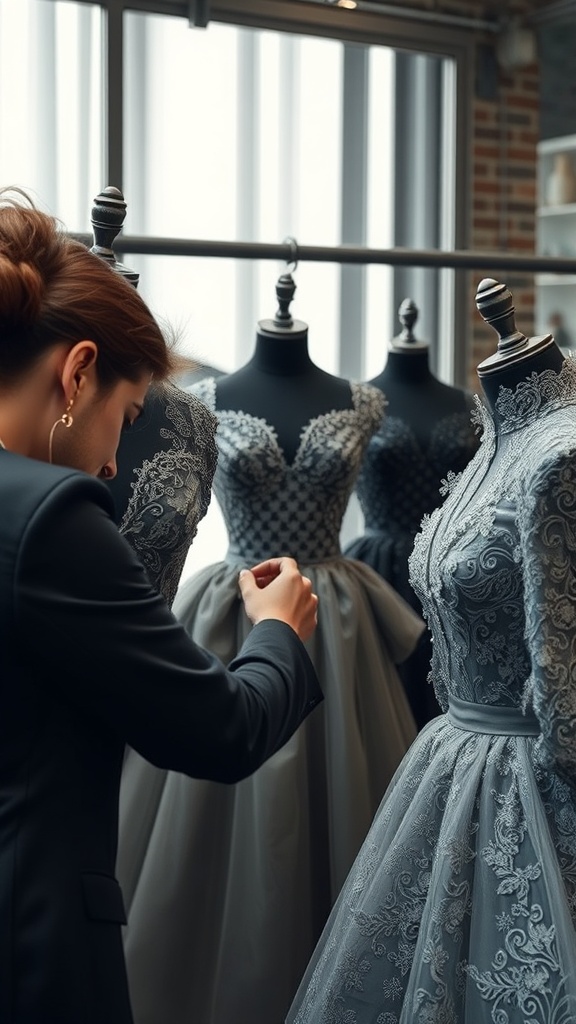
After sketches are finalized, the designer or head pattern maker creates a bespoke pattern. Many couture ateliers still drape fabrics directly on a dress form to sculpt the silhouette in three dimensions, refining shapes in real time. This hands-on draping ensures that lines flow with the body’s form rather than being merely translated from flat paper.
Toile (muslin) and initial fitting
A toile, typically constructed in muslin, is sewn to test fit and proportions. This mock-up allows the client and designer to assess balance, ease, and movement before committing to precious fabrics. Multiple fittings may be scheduled, with each session narrowing adjustments—shoulder lines, bust fits, jawline of a neckline, and hem lengths—until precision is achieved.
Construction and handwork
True couture is defined by handcraft.
Seams are often reinforced with hand-stitching, linings are hand-basted, and hems may be slip-stitched by hand for an invisible finish. Complex embellishments—hand-embroidered motifs, beadwork, tambour stitching, and appliqué—are executed by specialist artisans in the atelier.
This phase can be the most time-intensive, sometimes consuming hundreds of artisan hours depending on the detail.
Final fittings and finishing touches
Final fittings address minute adjustments and ensure the garment performs in movement and under different postures. Once the client is satisfied, finishing touches are applied: pressed seams, careful steaming, and any detachable elements like overskirts or capes are perfected. The garment is then prepared for presentation or delivery, often accompanied by care instructions and storage solutions to preserve the piece.
Why couture matters
Couture represents the apex of tailoring knowledge and creative collaboration. It offers fit and personalization unattainable in ready-to-wear, along with tangible cultural value preserved by artisan skills. Even as digital tools like CAD and 3D prototyping become more common for visualization, the essence of couture remains in the touch of hand-finished seams and the relationship between client and maker.
Experiencing an atelier firsthand is the best way to understand couture’s nuance. For those commissioning a piece, patience and clear communication yield the most rewarding results—pieces that are not just garments, but living expressions of craft and individuality.